Let’s start by explaining what computer-aided engineering stands for.
Computer-aided engineering, or “CAE” for short, involves the use of computers for industrial design applications.
A characteristic of this process is the ability to directly transform design drawings, developed and possibly modified during the design process, into instructions for production machines that create the desired object.
Computer-aided engineering is standard in nearly every industry that uses some type of design software for product development.
Why choose computer-aided engineering?
“CAE” not only ensures seamless product design but also provides optimal support in the engineering process. By using computer-aided engineering, you have the possibility to conduct tests and simulations of the product’s physical properties without needing a physical prototype.
In the comprehensive context of CAE, the most commonly used simulation analysis types are:
- finite element analysis
- computational fluid dynamics
- thermal analysis
- multibody dynamics
- optimizations
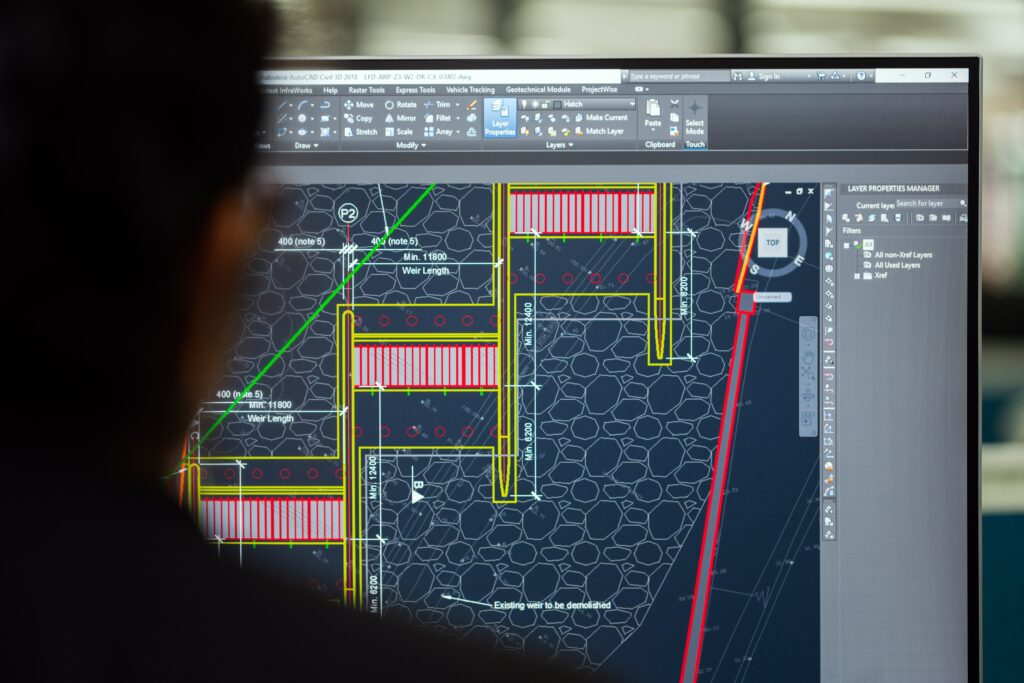
Is computer-aided engineering an advantage?
By leveraging the many benefits of technical simulation, particularly in combination with the power and speed of high-performance cloud computing, the cost and time of each iteration cycle of the design and the overall development process are significantly reduced.
In the event of weaknesses after a design simulation in the digital prototype, NESKO Engineering can improve the CAD model and retest the effects of the updated design.
In this way, NESKO Engineering offers you faster and more efficient product development since it is not necessary to build a physical prototype in the early stages of development.